Cortex XDR, Unit 42, and the Modern Threat Landscape
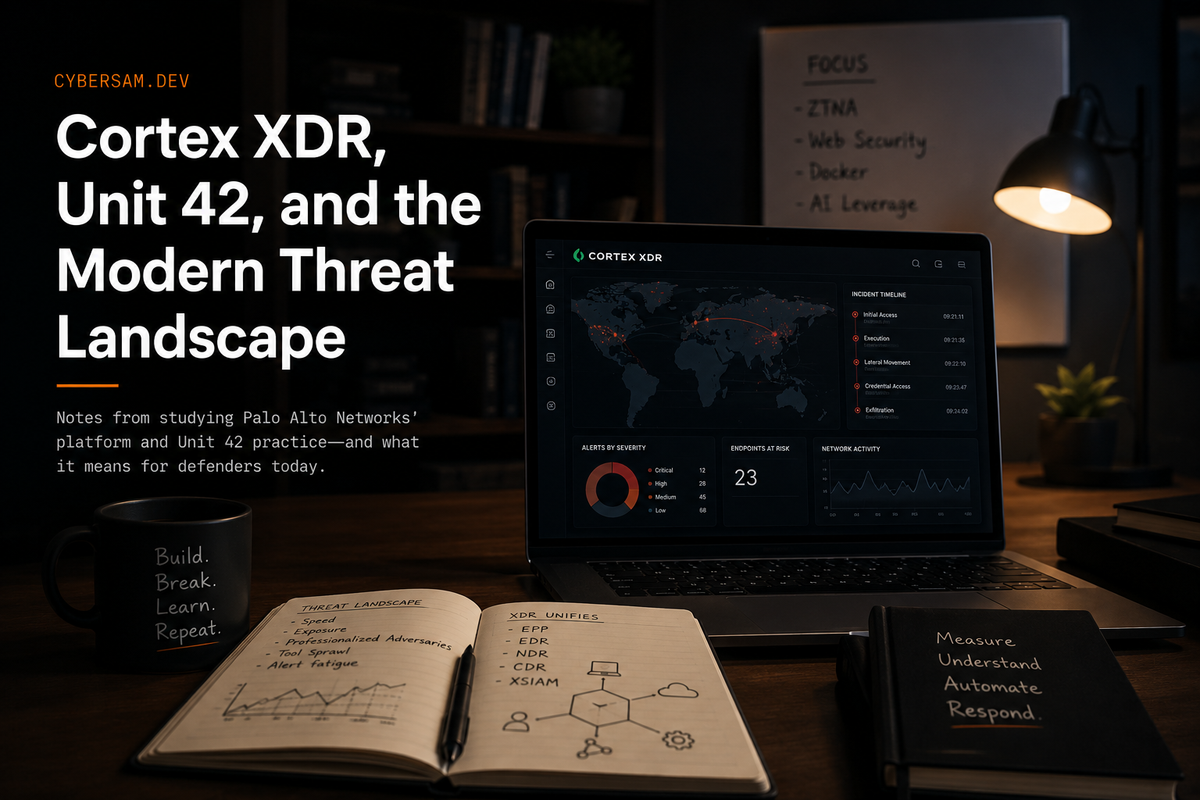
I work in enterprise security at Fortinet. At one point in the past, I was seriously exploring an opportunity at Palo Alto Networks, for which I was studying their Cortex XDR platform and Unit 42 practice in genuine depth, not surface-level enough to pass a phone screen, but deep enough to speak credibly about architecture, licensing, and business value with a CISO. This post is the result of that study. These are my personal study notes, not an official position from Fortinet or any vendor discussed here.
Where it's relevant, I'll draw comparisons to Fortinet's equivalent products. I work with FortiManager and FortiAnalyzer regularly, and Fortinet's security fabric covers most of the same problem space through different architecture and different implementation choices. The comparisons aren't here to score points for either vendor; both are serious platforms and the honest answer is that the right choice usually depends heavily on what the customer already has deployed. They're here because having a real reference point makes both platforms easier to understand.
The Threat Landscape Has Actually Changed
Before getting into the platform, the threat landscape framing matters, not as a sales preamble, but because it explains why the architecture exists.
The commonly cited Unit 42 incident-response statistics tell a specific story: the attack window is collapsing. In 2024 reporting, Unit 42 observed that about 45% of cases involved data exfiltration within 24 hours of compromise, and exploitation of internet-facing vulnerabilities had risen sharply as an initial access vector. In the latest reporting, the speed problem is even clearer: the fastest quarter of intrusions reached exfiltration in about 1.2 hours, down from 4.8 hours the prior year, and 22% of incidents reached exfiltration in under an hour.
The bigger point is not that phishing disappeared or that one entry vector permanently replaced another. It is that attackers are moving across identity, exposed services, cloud/SaaS gaps, and software supply chain paths faster than traditional SOC workflows can comfortably handle.
The adversary model has also professionalized. The lone-wolf attacker in a basement is mostly a relic. Modern threat actors operate as organized, specialized groups with internal division of labor:
- Initial access brokers find vulnerabilities and establish footholds in corporate networks, then sell that access on dark web marketplaces without using it themselves.
- A second team buys that access and handles lateral movement and privilege escalation.
- A third team handles data exfiltration and deploys the ransomware payload.
The business impact is not just technical containment. Breaches create recovery cost, downtime, customer trust damage, legal exposure, and executive-level scrutiny. The faster the attack lifecycle gets, the less useful a slow detection-and-response process becomes.
Security teams are also drowning in alert volume. In many enterprise environments, dozens of tools produce alerts across separate consoles, each with its own context and workflow. Alert fatigue is real, and it has consequences: analysts start tuning out noise, and the signal gets buried.
This is the problem Cortex XDR is built to solve.
What XDR Actually Means
XDR stands for Extended Detection and Response. The term was coined in 2018 by Palo Alto's CTO Nir Zuk. The "Extended" is the operationally meaningful part: it breaks down the silos between security tools that have historically operated as separate, disconnected reporting systems.
Traditional security stacks produce disconnected outputs. An endpoint security tool generates one alert. A network monitoring tool generates another. A cloud security system generates a third. Each speaks its own language and outputs data into its own console. Correlating across them to determine whether three separate alerts represent three independent events or one coordinated attack is manual, slow, and heavily dependent on analyst experience.
XDR addresses this by ingesting telemetry (not just logs or alerts) from all of those sources into a single unified data lake, then applying AI and machine learning to correlate it into incident timelines automatically. The distinction between telemetry and logs matters: logs are discrete text-based records of specific events. Telemetry is the broader continuous stream of data from network traffic, endpoint behavior, cloud workloads, and identity systems. XDR needs the raw telemetry, not just the filtered output, to build a complete picture.
A useful way to understand Cortex XDR is that it pulls detection and response context from several domains that used to be handled separately:
EPP (Endpoint Protection Platform): Security deployed on devices to prevent malware and advanced threats before they execute. Uses antivirus, behavioral analysis, and AI to secure laptops, servers, and mobile devices. The bouncer at the door, focused on prevention.
EDR (Endpoint Detection and Response): Agents installed on devices that continuously record activity (process executions, file modifications, network connections) and detect malicious behavior using signature and heuristic analysis. Where EPP focuses on prevention, EDR focuses on detection and response after something gets past the perimeter. The undercover security inside the venue. Both EPP and EDR are scoped to the device itself.
NDR (Network Detection and Response): Monitors and analyzes network traffic to detect malicious activity that endpoint tools can't see. If a compromised printer starts moving laterally toward a database server, no agent on the printer will catch it, but NDR will, because it's watching the traffic between them. Highway patrol monitoring traffic across the network.
Cloud detection context: Cloud environments introduce workload patterns that traditional endpoint tooling was not designed around: containers, Kubernetes clusters, ephemeral compute, cloud control-plane activity, and identities that may matter as much as hosts. Some cloud systems can run agents like traditional servers; others require cloud-native telemetry and runtime visibility instead.
UEBA (User and Entity Behavior Analytics): Doesn't look at files or packets. Looks at behavior. Login times, access patterns, data transfer volumes, geographic anomalies. UEBA establishes a mathematical behavioral baseline for each user and entity and detects deviations from it. This is how insider threats, compromised accounts, and lateral movement appear when the attacker is using legitimate tools and credentials.
In a legacy environment, each of these domains produces its own report. The EPP flags a suspicious executable. NDR flags unusual traffic. UEBA flags an anomalous login. Determining whether these are three unrelated events or a single coordinated attack requires an analyst to manually pull reports from three different systems and build the timeline by hand. Hours or days of work. Cortex XDR ingests all of that telemetry and correlates it automatically into a single unified incident story.
Fortinet parallel: Fortinet's answer to this is in the Security Fabric, an architectural framework connecting FortiGate firewalls, FortiEDR, FortiXDR, FortiSIEM, and other products into an integrated ecosystem. FortiXDR extends Fortinet's Security Fabric approach by correlating signals across Fortinet controls and using automation/AI to support detection, investigation, and response. The underlying goal is the same: unified visibility and correlated detection across a complex environment. The implementation differs: the Security Fabric is more modular and integrates deeply with existing FortiGate infrastructure, while Cortex XDR is more platform-native.
Cortex XDR Features Worth Understanding
Root Cause Analysis
When the platform detects a threat, it triggers Root Cause Analysis: a visual reconstruction of the entire attack chain. Not just an alert saying "malicious process detected on endpoint X." A graphical depiction of what happened: parent processes, child processes spawned, registry keys touched, IP addresses connected to, the specific user account logged in at the time.
An example of what this looks like in practice: a network sensor detects a beacon reaching out to a command-and-control server. When the relevant telemetry is present, Cortex XDR can stitch the network event back to the endpoint, process tree, user context, file activity, and related alerts, grouping them into a unified incident report.
The documented impact: 88% reduction in investigation time and 98% reduction in alert volume. That second number is the one that matters most for the alert fatigue problem. The 98% reduction comes from correlation: what previously appeared as hundreds of separate alerts across multiple systems gets collapsed into a handful of unified incidents, each with full context.
Live Terminal
Once a threat is identified and needs to be remediated, live terminal gives a security analyst direct, secure access to the command line of any endpoint anywhere in the world, without disrupting what's happening on that machine.
With Live Terminal, an analyst can remotely access the endpoint through the Cortex XDR agent, inspect processes and files, run commands, collect evidence, and take response actions without requiring the user to walk through every step manually. Exactly how visible that session is to the endpoint user depends on policy and configuration.
Built-In Endpoint Controls
Beyond detection and response, Cortex XDR can serve as the endpoint protection layer instead of a separate legacy antivirus product, and extends to include USB device control (blocking malicious thumb drives), a host firewall managed from the central console, and disk encryption management that hooks into native tools like BitLocker on Windows and FileVault on Mac. All of this through a single lightweight agent, all visible and configurable from the same platform.
Licensing Structure
A common initial objection to XDR: ingesting petabytes of telemetry from endpoints, networks, and clouds sounds financially ruinous. The licensing structure is specifically designed to address this.
The licensing model is designed around the kind of telemetry being protected or ingested. Exact SKU names can change, but the mental model is simple: endpoint and on-prem host coverage, cloud and container workload coverage, and volume-based ingestion for network or third-party data sources.
Endpoint coverage: The foundational tier provides best-in-class EPP without continuous heavy data ingestion. Adding EDR capability brings endpoint agent data that is highly compressed before ingestion to minimize bandwidth and storage costs while enabling deep investigation capability.
Cloud and container workload coverage: Built for cloud hosts and containerized environments, where workloads may be short-lived, dynamically scaled, or orchestrated differently from traditional fixed endpoints.
Per-GB network ingestion: Licenses network and third-party log ingestion by volume. This is where NDR capability lives. Network data is the highest-volume input and the most storage-intensive. The per-GB model allows organizations to be surgical: deploy EDR agents on endpoints to reduce reliance on NDR, and then use per-GB ingestion for IoT devices, legacy equipment, and systems that can't host an agent.
Additional capabilities and integrations can expand investigation depth, malware analysis, threat intelligence enrichment, vulnerability visibility, and proactive threat hunting.
Unit 42: The Human Layer
The best security platform is still a tool. Tools process what they're given and respond according to their training. Against a sufficiently sophisticated adversary, one actively adapting, using legitimate tools, and reading the same AI research papers your platform is trained on, a tool alone has limits.
Unit 42 is Palo Alto's threat intelligence and incident response practice. It's what separates the platform from a software product. Threat hunters, incident responders, and malware analysts who have been deconstructing attacks for over a decade. They process over 30 million new malware samples and 500 billion events daily, drawing from telemetry across more than 80,000 global Palo Alto customers. That gives Unit 42 a very large intelligence base to draw from, especially when combined with incident-response experience and product telemetry.
The practical effect of that scale: when a zero-day hits a financial institution on a Tuesday, Unit 42 deconstructs the attack, extracts the indicators of compromise, and the intelligence propagates across Palo Alto's customer base. The lesson from one incident can inform detections, indicators, hunting logic, and response guidance elsewhere. A customer does not need to personally experience every attack for the broader ecosystem to learn from it.
MDR vs MTH: The Distinction Matters
MDR (Managed Detection and Response) is response-oriented managed monitoring. Unit 42 analysts monitor the environment, triage detections, and help contain threats when something suspicious is found.
MTH (Managed Threat Hunting) is more proactive. Analysts hunt through telemetry under the assumption that a quiet compromise may already exist and has not triggered a clean alert yet. They dive into Cortex telemetry and Palo Alto threat-intelligence context to hunt for unknown unknowns: threats that haven't triggered any alert, that haven't matched any signature, that are sitting quietly in the environment waiting.
MTH requires a Managed Threat Hunting license and a Cortex XDR license with at least 500 endpoints. The reason is statistical: behavioral baselining through machine learning needs sufficient data volume to distinguish genuinely anomalous activity from normal variance. The math doesn't work at small scale.
MTH outputs two types of deliverables: technical threat reports for the security engineering team, and impact reports for the executive layer. The impact report matters specifically for CISOs who have to justify the security budget upward. When a new zero-day is disclosed publicly, the CISO with MTH can walk into the CEO's office within an hour of the news breaking and present exactly what threat actors were hunted for and what the organization's exposure was. That's a different conversation than "we're still assessing."
The Incident Response Retainer
For qualified customers and specific programs, Unit 42 has offered no-cost rapid IR retainers that include up to 250 hours of initial incident response services and a two-hour response-time agreement. The important point is not that every customer automatically gets this, but that Palo Alto has packaged Unit 42 response capacity as a formal readiness and response offering.
Case Study 1: Telecom Ransomware
A telecom provider suffered a fast-moving ransomware attack. The attack started with a single phishing email click and resulted in complete operational failure within 13 hours. Half the business at a standstill, sensitive data exfiltrated and files encrypted across a large part of the environment.
The client activated the Unit 42 IR retainer. Unit 42 engaged within the two-hour SLA and immediately ran into the core problem: the client's legacy security tools didn't provide the visibility required to understand how the attackers were moving through the environment. The investigation couldn't proceed without being able to see the environment properly.
Unit 42 made a deliberate decision: deploy Cortex XDR agents across the impacted environment first. That took 96 hours. Taking time to deploy tooling mid-incident is counterintuitive; it feels like it delays the response. The analogy that captures why it's correct: trying to catch a trained team of burglars in a pitch-black warehouse where your security guards are running around with flashlights bumping into each other. Wiring up stadium-level floodlights takes a moment, but once you flip the switch, the burglars have nowhere to hide.
With Cortex XDR deployed, Unit 42 established immediate centralized visibility, stood up 24/7 monitoring, and ran aggressive threat hunting to close every backdoor and eradicate every attacker from the environment. Once that was complete, they determined precisely what had been stolen versus what had been encrypted, advised the client on ransom negotiations, and negotiated an 80% reduction in the original ransom demand, along with securing decryption keys for data recovery.
After the immediate crisis was resolved, Unit 42 conducted a full post-incident architectural review, identified every gap that enabled the breach, and helped the client deploy new controls to address them. The engagement turned a catastrophic breach into a documented security transformation.
Case Study 2: Muddled Libra
Muddled Libra is one of the most well-documented and sophisticated active threat actor groups. A single client was targeted by five separate attacks from this group within a single week.
The attacks didn't use malware. Muddled Libra used living-off-the-land techniques: malicious use of legitimate tools already present in the environment, such as PowerShell, WMI, and built-in administrative utilities. Because the tools being used are the same ones system administrators use for legitimate work, traditional EPP tools don't flag the activity. It looks normal.
Unit 42's advantage here is accumulated institutional knowledge. They've been tracking Muddled Libra's behavioral patterns for years across multiple engagements. They know the subtle patterns that distinguish Muddled Libra's use of PowerShell from a system administrator's use of PowerShell: timing, sequence, call structure, targets. Those patterns are invisible without the context of having seen the same group operate across dozens of environments.
Since Muddled Libra had deeply compromised the environment, Unit 42 had to simultaneously help reconstruct the client's Active Directory infrastructure while hardening their firewall configuration and deploying Cortex XDR across the environment to gain the visibility needed to track the adversary's movements.
The lesson from this engagement: against sophisticated, human-operated, actively adapting adversaries, automated tools are necessary but not sufficient. A threat actor operating living-off-the-land techniques specifically because they know those techniques evade automated detection requires human defenders with deep contextual knowledge to identify them. XDR provides the visibility and the data. Unit 42 provides the pattern recognition that turns that data into actionable intelligence against a specific adversary.
Fortinet parallel: FortiGuard Labs is Fortinet's threat intelligence and research engine, and its intelligence powers FortiGuard security services across the Security Fabric. Fortinet also offers managed detection and response, SOC-as-a-Service, and incident response services. The difference is mostly branding and packaging: Palo Alto presents Unit 42 as a combined threat intelligence, incident response, consulting, and managed-services practice, while Fortinet tends to separate the FortiGuard Labs intelligence function from the broader FortiGuard services portfolio.
XSOAR: The Automation Layer
If Cortex XDR is the analytical engine that finds threats and correlates incidents, XSOAR (Extended Security Orchestration, Automation and Response) is the automated dispatch system.
XSOAR ingests confirmed incidents from XDR and executes IR playbooks automatically. When XDR correlates an alert and identifies a set of compromised endpoints, XSOAR can simultaneously: query Active Directory to pull context on the affected user accounts, issue an isolation command to the third-party firewall to block the relevant IPs, open a ticket in Jira or ServiceNow, and send an automated Slack message to the security team, all without an analyst lifting a finger.
Cortex XDR becomes the analytical brain. XSOAR becomes the hands. The combination is what makes a closed-loop response model practical rather than theoretical. XSOAR supports a large marketplace of prebuilt integrations and content packs, including 850+ product integrations according to Palo Alto's public marketplace language, which matters because no enterprise runs a single vendor's stack exclusively. The integrations make XDR usable as the orchestration center for a heterogeneous environment.
Fortinet parallel: FortiSOAR is Fortinet's SOAR platform. Similar function: automated IR playbooks, cross-platform orchestration, incident management. FortiSOAR integrates with the Security Fabric and supports integrations with third-party tools for organizations running mixed environments.
The NGFW Foundation
XDR and MDR solve the detection and response problem. The NGFW (Next-Generation Firewall) is the foundational security control that sits upstream of all of it, and understanding the difference between a traditional firewall and an NGFW is worth covering in some depth.
Traditional Firewall vs NGFW
A traditional stateful firewall operates at Layer 3 and Layer 4 of the OSI model. It inspects IP addresses, ports, and protocols. In a simplified example, a stateful firewall may allow TCP traffic on ports 80 and 443 while blocking other traffic based primarily on source, destination, port, protocol, and session state. This model was effective until attackers learned that port 80 and 443 are always open, and started encapsulating their malicious traffic (command-and-control communications, peer-to-peer file sharing, data exfiltration) inside HTTP and HTTPS traffic on those ports. A Layer 4 firewall sees the port, sees that it's in the allowlist, and passes the traffic through, completely blind to what's inside.
An NGFW performs deep packet inspection, inspecting traffic up to Layer 7 (the application layer). This is where Palo Alto's APP-ID comes in.
APP-ID is the mechanism that defeats port-based evasion. It doesn't care what port the traffic is using. It analyzes the actual traffic patterns, behavioral signatures, and application-layer characteristics to identify the specific application generating the traffic. If a user attempts to run BitTorrent over port 443, a common evasion technique, APP-ID inspects the behavioral signature, determines that the traffic is not legitimate HTTPS despite the port, identifies it as BitTorrent, and applies the security policy for that specific application. The policy decision is now about the application, not the port.
This shifts the entire paradigm from port-based security to application-based security. It's a foundational change in how firewall rules are written and enforced.
Scaling to a Global Environment: Panorama
A single NGFW understanding application traffic is useful. Understanding how to manage 50 firewalls across London, Tokyo, and New York consistently is a different problem. Panorama is Palo Alto's centralized management platform.
Panorama allows a security team to use device groups and policy templates to push consistent security policies to every firewall simultaneously. One policy change at headquarters propagates globally in a single operation. Panorama centralizes management and visibility for distributed Palo Alto firewalls. Depending on the deployment, firewall telemetry can be centralized through Panorama, log collectors, or Palo Alto's cloud logging services, which then become important inputs for investigation and response workflows.
Fortinet parallel: FortiManager is Fortinet's centralized management platform for FortiGate firewalls. It provides the same core capability: policy management across multiple devices, template-based configuration, centralized visibility. I work with FortiManager regularly; the operational model of using device groups and policy packages to manage distributed FortiGate deployments is functionally similar to Panorama's approach. FortiManager maps most closely to Panorama for centralized firewall management. FortiAnalyzer maps more closely to the logging, analytics, and reporting layer for Fortinet environments rather than to Panorama itself.
High Availability: Active/Passive vs Active/Active
Any firewall deployed in an enterprise environment needs a high availability configuration. Two models:
Active/Passive: One firewall actively processes 100% of traffic. The second is physically connected and synchronized but sitting in standby, waiting for the primary to fail. When the primary fails, the standby assumes the primary's IP addresses and takes over the traffic load; if session synchronization is functioning correctly, existing sessions can often be preserved or disruption can be minimized. Simpler to configure and operate, appropriate for most enterprise environments.
Active/Active: Both firewalls actively process traffic simultaneously. Used in environments requiring maximum throughput or complex asymmetric routing. Significantly more complex to configure correctly because session synchronization must happen across both firewalls in real time; if traffic for the same session enters on one firewall and exits on the other without proper synchronization, packets get dropped.
The business framing for Active/Active: for a global high-frequency trading firm where a five-millisecond delay in firewall processing can cost millions, the additional throughput of Active/Active justifies the configuration complexity. The tradeoff is real on both sides. Most environments don't need it.
Business Value and Independent Validation
The platform-level claim Palo Alto makes: Cortex XDR lowers Total Cost of Ownership (TCO) by 44% on average compared to a traditional legacy security stack. The components of that reduction:
Tool consolidation: Natively integrating EPP, EDR, NDR, UEBA, and cloud detection capability allows customers to sunset separate licensing contracts for products that previously covered each domain independently. Immediate, measurable hard dollar savings.
Existing infrastructure leverage: Cortex XDR ingests telemetry from third-party firewalls and identity providers the customer already owns. There is no required rip-and-replace of the existing environment to get value from the platform.
Infrastructure elimination: The largest cost reduction category. XDR is cloud-delivered. It eliminates the need for customers to maintain on-premises log servers (hardware, licensing, rack space, power, cooling, and database administration overhead all move off the customer's balance sheet).
Ecosystem integration: Through XSOAR, Cortex XDR automates response workflows across the customer's existing third-party tools, reducing the manual analyst workload that represents significant operational cost at scale.
Beyond marketing claims, two independent validation points are worth knowing:
In Palo Alto's interpretation of the 2023 MITRE Engenuity ATT&CK Evaluation Round 5 results, Cortex XDR delivered 100% protection, 100% visibility, and 100% analytic coverage, with no configuration changes or delayed detections. The caveat: MITRE evaluations are not traditional ranked bake-offs, so the safer way to frame this is as a strong independent-evaluation data point rather than a simple vendor leaderboard.
In AV-Comparatives' 2024 Endpoint Prevention and Response test, Palo Alto Networks Cortex XDR Pro was certified and placed in the Strategic Leader category.
Where the Industry Is Going
The question worth thinking about: as AI models become increasingly capable of predicting attack paths, detecting microscopic behavioral anomalies, and executing complex remediation playbooks autonomously at machine speed, what happens to the human threat hunter?
Cortex XDR is already grouping alerts intelligently and automating containment through XSOAR playbooks. The trajectory of AI in security points toward models that write their own detection rules, execute increasingly complex response sequences without human intervention, and eventually operate entire SOC functions autonomously.
The case studies above push back on a naive interpretation of that trajectory. Muddled Libra specifically exploited the predictability of automated defenses. They read the same research on AI detection models that defenders read. When automated scripts get blocked, sophisticated human threat actors pivot in real time, adapting their techniques, changing their tooling, exploiting the gap between the threat model an AI was trained on and the novel variation the attacker just invented.
The more interesting question isn't whether AI replaces human threat hunters. It's how the relationship between them evolves. The plausible near-term model: AI handles everything that fits within known behavioral patterns at machine speed, freeing human analysts to focus on the genuine unknowns: the novel techniques, the creative pivots, the psychological dimension of understanding what a specific adversary is trying to accomplish and how they'll adapt when their current approach is blocked. AI elevates what human analysts can do by removing the noise they currently drown in.
Whether that dynamic holds over a ten-year horizon is the more open question. As AI models become better at creative generalization, not just pattern matching but genuine inference about novel attack strategies, the boundary between what requires human intuition and what can be automated will keep moving. It will move faster than most organizations are currently prepared for.
The more pressing organizational question for most security teams isn't where that boundary will land in a decade. It's whether their current architecture (the disconnected, alert-flooding, analyst-exhausting legacy stack) can handle the next 12 months.