Customer Success in Enterprise, Part 1: Foundations, Metrics & Methodology
I spent time studying the customer success discipline properly — not surface-level, but the frameworks, metrics, and mental models that people operating in enterprise CS roles actually use. I cared about this because I kept seeing TAM, CSM, SE, and advisory roles blur together from the outside. Thees sounded familiar, but the operating model underneath them was different from TAC. I wanted to understand the actual business mechanics: what these teams own, how they are measured, and why customer success is treated as a revenue function instead of just "being helpful after the sale.
These two posts are the result of that. Same format as the other series: my notes, organized and written by an LLM into something readable.
Part 1 covers the conceptual foundation: what TAMs and CSMs own, the customer lifecycle, the vocabulary you need to operate fluently in the space, the KPIs that define the job, and the methodologies the industry has built up around it. Part 2 covers the operational layer — the frameworks, processes, and playbooks that turn the theory into practice.
The Roles: CSM and TAM
The titles are used differently across companies. Sometimes they're interchangeable. Sometimes one is senior to the other. What matters is understanding what each is expected to own.
CSM (Customer Success Manager): Post-sale relationship ownership. Primary accountability covers adoption, health, retention, and expansion across an account portfolio. Program-level ownership of the customer relationship from onboarding through renewal.
TAM (Technical Account Manager): Same ownership as a CSM, with deeper technical credibility expected. A TAM bridges the customer's technical team and the vendor's engineering and support organization. Escalation ownership, architecture reviews, and platform optimization are part of the job alongside the standard CSM responsibilities.
In practice at many technical enterprise companies, TAM roles are CSM work plus technical depth. Most CSM roles at technical companies also expect enough product fluency to have meaningful architectural conversations. The line is calibrated to the specific role and company.
What the Job Actually Requires
Five accountabilities, running simultaneously across a portfolio:
Get customers adopted and realizing value. The deal closing is not success. The customer achieving the outcome they purchased for is success. Getting them there — through onboarding, enablement, and removing friction — is the first job.
Keep them. Prevent churn. Protect recurring revenue. Most of the revenue risk in a SaaS business is not from poor sales performance — it's from customers who renew poorly, downgrade, or leave. Reducing that is the core commercial function of CS.
Grow them. Identify expansion signals and surface them. Upsell, cross-sell, seat expansion, scope expansion — the commercial growth from existing customers is often larger than new acquisition over time. CS owns the signals; sales usually closes the commercial conversation.
Be the internal voice of the customer. Channel what you're hearing from customers into product, engineering, and leadership in a form that's actionable. Not individual complaints: patterns, quantified impact, business cases.
Own the relationship through the hard moments. Escalations, business reviews, renewals, stakeholder changes, expectation gaps. These are not exceptions to the job. They are the job.
The Customer Lifecycle
Enterprise CS ownership spans four stages, each with distinct accountabilities:
Onboarding
- Kickoff call and goal alignment
- Technical setup and integration support
- Training and enablement
- Time-to-first-value milestone tracking
Adoption
- Feature utilization tracking
- Health score monitoring
- Removing friction and blockers
- Identifying disengagement early
Value Realization
- QBR and EBR delivery
- ROI documentation
- Tying usage data to the business outcomes the customer stated at purchase
- Executive-level storytelling
Renewal and Expansion
- Renewal risk identification and mitigation
- Upsell and cross-sell signal surfacing
- Renewal conversation ownership and handoff to sales where needed
The Language of Customer Success
These terms are the operating vocabulary of the discipline. Using them correctly and in context signals fluency. Most of them have precise definitions that matter.
NRR / NDR (Net Revenue Retention / Net Dollar Retention): The single most important metric in CS. Calculated as: starting ARR plus expansion minus churn minus downsell, divided by starting ARR. NRR above 100% means expansion is outpacing loss, the existing customer base is growing without any new acquisition. In enterprise SaaS, 120%+ is often treated as a best-in-class range, though benchmarks vary heavily by segment, ACV, and pricing model.
GRR (Gross Revenue Retention): Revenue retained from existing customers, excluding expansions. Pure churn prevention measure. GRR tells you how well the team is protecting what's already been sold. Strong enterprise GRR often sits in the high-80s to mid-90s, with 90%+ generally treated as a healthy target. The relationship between GRR and NRR: GRR is the floor, NRR is the ceiling.
ARR / MRR (Annual / Monthly Recurring Revenue): The baseline commercial metric. Every account in a portfolio represents a specific amount of ARR, and every CS action has a relationship to protecting or growing that number.
Churn: Revenue lost from customers who cancel or downgrade. Voluntary churn (the customer chose to leave) and involuntary churn (payment failure, contract non-renewal by error) are tracked separately. Voluntary churn prevention is the primary CS commercial accountability.
Expansion: Additional revenue from existing customers. Upsell (larger tier, more seats, more licenses) and cross-sell (additional products in the vendor's portfolio). CS owns the signals and the conditions; sales typically handles the commercial close.
CSAT (Customer Satisfaction Score): Transactional survey score, typically collected after specific interactions. Measures satisfaction at a point in time. Scale varies, commonly 1-5 or 1-10. CSAT is a lagging indicator: by the time it drops, something earlier in the relationship has already degraded.
NPS (Net Promoter Score): Relationship survey, collected periodically. Respondents are asked how likely they are to recommend the product. Promoters (9-10) minus Detractors (0-6) equals NPS. It is calculated from percentages, but usually expressed as a score from -100 to +100. A score around +30 is often treated as strong for B2B, and +50 as excellent, though benchmarks vary by industry. A Promoter can be an expansion and referral opportunity. A Detractor needs a structured recovery plan.
Health Score: A composite score predicting likelihood to renew and expand. Typically combines product usage frequency, engagement metrics, CSAT trend, support ticket volume, and recency of executive contact. The specific inputs and weighting are defined by each CS team. The direction of the trend matters more than any single data point.
Time-to-Value (TTV): Days from contract signature to the customer's first meaningful, measurable outcome. One of the most important onboarding metrics. Shorter TTV often correlates with higher long-term engagement and renewal, because customers who experience value quickly are more likely to stay active. TTV is a predictive indicator, not just an operational one.
QBR / EBR (Quarterly Business Review / Executive Business Review): Structured meetings reviewing outcomes, risks, and forward plans. QBR is operational, held quarterly, typically with the day-to-day contacts. EBR is executive-level, held semi-annually or annually with C-suite stakeholders. Different audiences require different framing.
Success Plan: The written alignment document between the vendor and the customer. Not a kickoff slide or an implementation checklist. A living document that defines what success looks like for this customer, in their terms, with specific KPIs and milestones. Updated at each QBR.
Playbook: A documented process for handling a recurring customer scenario — onboarding, escalation, renewal risk, QBR. Playbooks make CS consistent and scalable across a team and allow new CSMs to operate effectively without reinventing the wheel for every situation.
CSP / CRM (Customer Success Platform / Customer Relationship Management): The primary tooling categories. CSPs like Gainsight, Totango, and ChurnZero handle health scoring, lifecycle management, and playbook automation. CRMs like Salesforce and HubSpot handle account history, opportunity tracking, and commercial reporting. Most enterprise CS teams run both in parallel.
Stakeholder Map: A documented picture of who matters at a customer account (economic buyers, champions, end users, blockers) and their relationship to the product and the renewal decision. The stakeholder map is a working document, not a one-time exercise.
Land and Expand: The sales and CS motion where a vendor wins a smaller initial deal and grows revenue through demonstrated value. Sales owns the land. CS owns the expand — creating the conditions where the customer discovers more value and scope grows naturally.
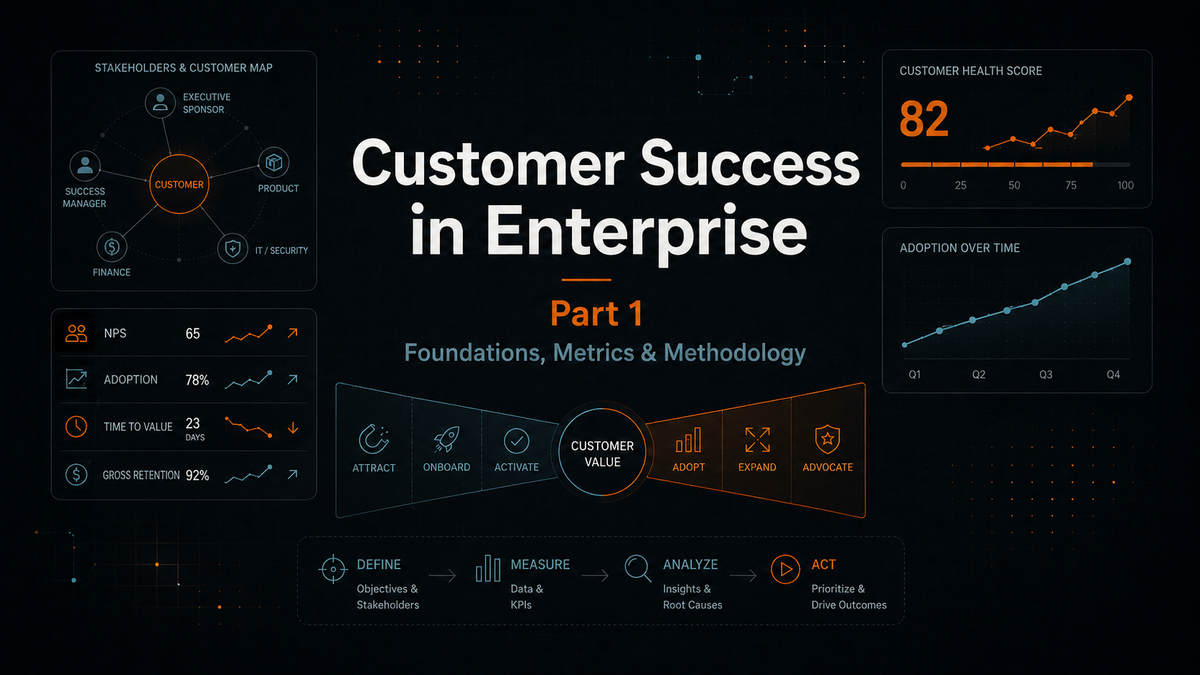
Bow-Tie Model: A revenue model representing the full subscription lifecycle. The traditional marketing funnel (acquisition) is the left side. The right side — retention, expansion, and advocacy — is the bow-tie's other half. In mature SaaS businesses, the right side is where most revenue potential lives over time. CS owns the right side.
Champion: The practitioner-level person at the customer who actively advocates for the product internally. Different from the economic buyer. The champion uses the product, believes in it, and influences peers and leadership. The most valuable individual relationship at any account.
Economic Buyer: The person who controls the budget and signs the renewal. May not be the day-to-day contact. Losing visibility into or access to the economic buyer is one of the earliest and most serious churn signals.
KPIs: The Metrics That Define the Job
The list below covers the main KPIs a TAM or CSM is typically measured against. Benchmark ranges are for B2B SaaS and enterprise software.
NRR
- Formula: (Starting ARR + Expansion − Churn − Downsell) ÷ Starting ARR × 100
- Benchmark: 110–130% elite; 100%+ strong; <90% concerning
- What it tells you: Whether the existing customer base is growing or eroding.
GRR
- Formula: (Starting ARR − Churn − Downsell) ÷ Starting ARR × 100
- Benchmark: 85–95% strong for enterprise
- What it tells you: How well churn is being prevented, independent of expansion.
Churn Rate
- Formula: Churned ARR in period ÷ Starting ARR × 100
- Benchmark: <5% annual strong; <2% best-in-class enterprise
- What it tells you: The rate at which contracted revenue is being lost.
CSAT
- Formula: Survey score, typically 1–5 or 1–10
- Benchmark: 4.2+ of 5 strong; trend direction matters more than one score
- What it tells you: Satisfaction at specific interaction points; a lagging signal.
NPS
- Formula: Promoters (9–10)% minus Detractors (0–6)%
- Benchmark: +30 strong; +50 excellent for B2B
- What it tells you: Relationship health across the portfolio; renewal and expansion proxy.
Time-to-Value
- Formula: Days from contract signature to first measurable customer outcome
- Benchmark: Varies by product; shorter is generally better
- What it tells you: One of the strongest onboarding indicators for long-term engagement and renewal.
Adoption Rate
- Formula: % of purchased features, seats, or licenses actively used
- Benchmark: Target 70–80%+ of purchased capability
- What it tells you: How embedded the product is in the customer's workflow.
Renewal Rate
- Formula: # or $ of contracts renewed ÷ total # or $ up for renewal × 100
- Benchmark: 90%+ strong; 95%+ best-in-class enterprise
- What it tells you: Commercial retention outcome.
Expansion Rate
- Formula: New expansion ARR in period ÷ Starting ARR × 100
- Benchmark: 15–25%+ of book-of-business is strong
- What it tells you: Revenue growth from existing customers.
Engagement Score
- Formula: Combination of login frequency, meeting attendance, response rates, and feature usage
- Benchmark: Internally defined; trend direction matters most
- What it tells you: A leading indicator that can decline weeks or months before formal churn intent surfaces.
How to think about KPIs as a system: Engagement is the leading indicator — it shows up first. Usage and adoption confirm whether the product is embedded in the customer's workflow. CSAT and NPS reflect sentiment, which lags engagement. Commercial metrics (NRR, GRR, churn rate, renewal rate) are the lagging outcome of all the layers above.
Tracking account-level expansion and contraction, rather than only aggregate NRR, matters because it reveals which accounts are growing versus at risk before the pattern becomes visible in portfolio-level numbers. The metric is only useful if it's being acted on at a granular enough level to drive intervention.
CS Methodologies
The CS industry has developed several common frameworks for thinking about the discipline.
The LAER Model
Developed by the Technology Services Industry Association. Land, Adopt, Expand, Renew. The four-phase lifecycle model for subscription and SaaS relationships.
Land: The sale closes. CS inherits the relationship. Onboarding begins.
Adopt: The customer starts using the product toward their stated goals. Time-to-Value is the key metric in this phase.
Expand: The customer grows beyond their initial purchase. CS owns the signals that feed expansion conversations.
Renew: The contract comes up for renewal. The entire body of work in the Adopt and Expand phases either supports or undermines this outcome.
CS owns primarily the Adopt, Expand, and Renew phases. Sales owns Land and has a role in Renew. The handoff between them — and the quality of that handoff — is one of the most impactful variables in customer success outcomes.
The Bow-Tie Funnel
The traditional marketing funnel runs left to right, ending at acquisition. The Bow-Tie model adds a right side: retention, expansion, and advocacy. In subscription businesses, the right side is where most of the revenue potential lives over time. Customer Lifetime Value grows because customers renew and expand, not only because the company acquires new ones.
This framing reframes the importance of CS in the business model. In SaaS with strong NRR, the existing customer base compounds over time. A company growing NRR at 120% is effectively growing revenue from customers it already has, independent of new sales activity. CS is not a cost center in this model — it is a revenue function.
Outcome-Based Customer Success
The shift from activity-based CS to outcome-based CS. Activity-based: did the QBR happen? Was the training delivered? Were the check-in calls completed? Outcome-based: did the customer achieve the business goal they stated at purchase?
The modern standard is outcome-based. Major CS platforms such as Gainsight, Totango, and ChurnZero support this shift through success plans, health scoring, playbooks, and lifecycle workflows.
In practice, it means defining success with the customer in their terms at onboarding — not in product terms. Tracking progress toward those outcomes. Making outcomes the currency of every QBR conversation.
"We processed 40,000 tickets this quarter" is an activity. "Your team's resolution time dropped 30% against the goal you set in month one" is an outcome. The second one is what earns a renewal.
The Maturity Model
Customers progress through stages of product use. The model describes four:
Reactive: The product works and they use it occasionally, but primarily when prompted or in response to a problem.
Proactive: The customer uses the product intentionally and regularly. There's a clear workflow connection.
Optimizing: The customer is actively getting value and wants more. Feature requests are coming in. They're asking about capabilities they haven't explored.
Transformative: The product is embedded in how the customer operates. Removing it would cause significant disruption. This is the stage where NRR is highest and churn risk is lowest.
CS work involves moving customers up this curve. The approach differs at each stage: reactive customers need a single high-value habit established. Proactive customers need optimization and advanced use cases. Optimizing customers are ready for expansion conversations. Transformative customers become references and design partners.
Higher maturity usually correlates with stronger retention and expansion when the maturity model is tied to real usage, outcomes, and stakeholder engagement. The curve is useful because it can become predictive, not just descriptive.
Jobs-to-Be-Done
Customers don't purchase products — they hire products to do a specific job. The job is the outcome they need to achieve, and the product is the mechanism they've chosen to achieve it.
This framework prevents the trap of measuring and reporting in product terms when the customer cares about a business outcome. In a QBR: "You hired this platform to reduce the manual reporting burden on your security team. Here's how we're doing against that job." That framing is more powerful than a feature utilization dashboard, because it connects directly to the reason the purchase was made.
When a customer says they're not seeing value, the JTBD framework is the right diagnostic lens: has the job changed, is the product doing the job but the customer can't see it, or is the product genuinely not doing the job?
Part 2 covers the operational layer: the eight CS frameworks, success plan structure, portfolio management, stakeholder mapping, discovery and kickoff calls, voice of customer, the sales-to-CS handoff, technical investigation methodology, expansion, QBR execution, and the tooling stack.