Customer Success in Enterprise, Part 2: Operations, Frameworks & Playbooks
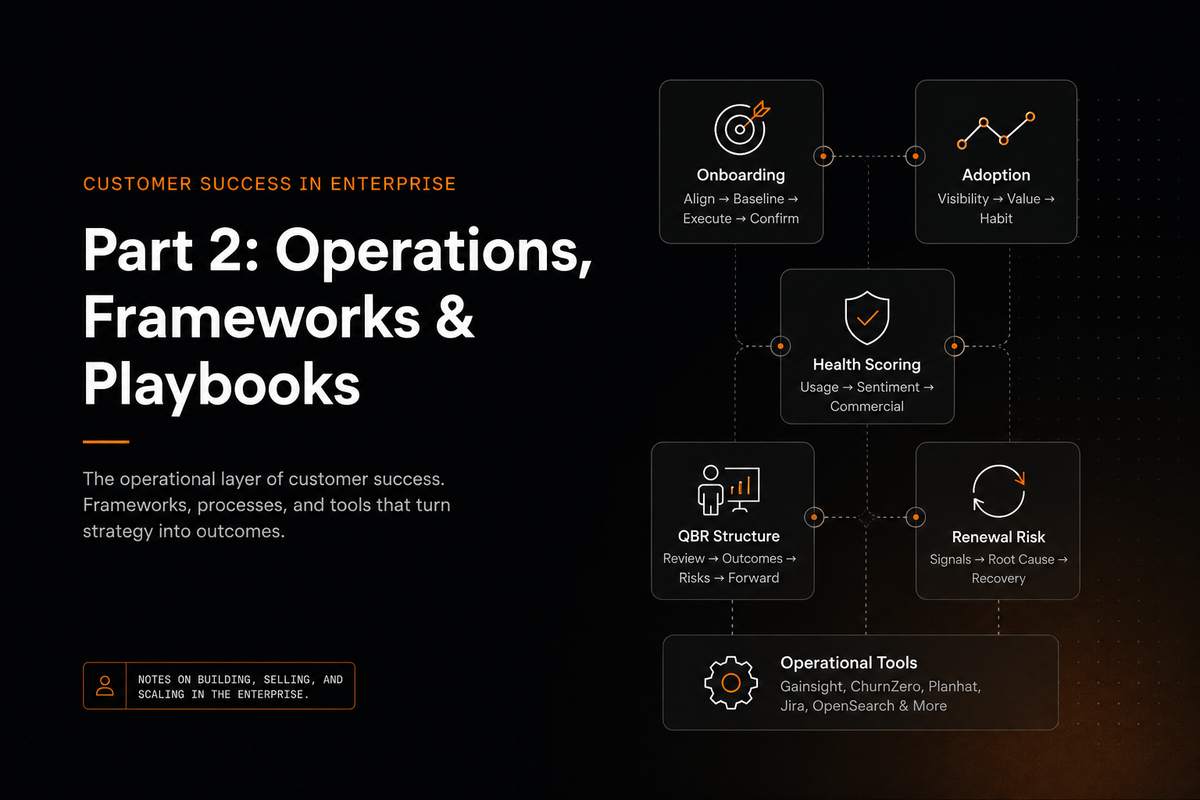
Part 2 continues from Part 1, which covered the roles, customer lifecycle, terminology, KPIs, and CS methodologies. This post is the operational layer: the frameworks, processes, and tools that make the theory functional.
The frameworks below are working models for how I think about CS execution. Some map to common industry practice, but the point here is operational clarity, not claiming every framework is an official taxonomy.
Framework 1 - Onboarding: Align → Baseline → Execute → Confirm
Onboarding sets the trajectory of every customer relationship. A lot of early-lifecycle churn that shows up six to twelve months in can be traced back to something that went wrong, or was skipped, during onboarding.
Align
- Define what success looks like to the customer
- Confirm what goals drove the purchase
- Identify what the executive sponsor needs to show internally
- Define what's vendor-owned vs. customer-owned
Baseline
- Map the environment and stakeholders
- Identify integration gaps and risks
- Confirm communication cadence and escalation path
- Define what "done" means for onboarding
Execute
- Run training and enablement
- Complete technical setup milestones
- Establish the operating cadence
- Track time-to-first-value closely
Confirm
- Validate that early outcomes were achieved
- Ensure the customer understands what they're getting
- Adjust based on first 30 days of feedback
- Formalize the written success plan
The Confirm phase is where most onboarding fails. The product is technically live, integrations are up, training was delivered, but the customer never had a moment of feeling successful. Confirm is the bridge from implementation to adoption. Skipping it is one of the most common ways early-lifecycle disengagement starts.
Framework 2 - Adoption: Visibility → Value → Habit
Adoption is not just feature usage. It's whether the product has become embedded in how the customer works.
Visibility
- Are key users actually logging in?
- Are they using features they paid for?
- Are the right stakeholders engaged?
Value
- Can they articulate what the product does for them?
- Are outcomes tied to their stated goals?
- Is there proof they can show their leadership?
Habit
- Is product use embedded in their workflow?
- Do they have a regular cadence with you?
- Would they notice if the product disappeared?
The last question in Habit is the test. If removing the product tomorrow would go unnoticed for a week, adoption is incomplete. If it would cause immediate disruption, adoption is real.
Diagnosing low adoption: it's almost always one of three problems. Training gap: they don't know how to use the product effectively. Fit gap: the product doesn't do what they need it to do for a specific workflow. Relationship gap: they're not engaged enough with you to invest in the product. Each requires a different response.
Framework 3 - Health Scoring: Usage → Sentiment → Commercial
Health scoring is not a dashboard feature; it's a diagnostic system. The three layers build toward a complete picture of account health.
Usage
- Login frequency by user segment
- Feature adoption vs. entitlement (what they're using vs. what they paid for)
- Support ticket volume and trend
- Days since last meaningful session
Sentiment
- CSAT / NPS trend direction
- Executive sponsor engagement level
- Champion responsiveness
- Open escalations or unresolved complaints
Commercial
- Renewal date and ARR at risk
- Expansion potential vs. current footprint
- Whether key stakeholders (champion, executive sponsor) have changed roles or left
- Contract compliance and utilization
Usage is the leading layer; it shows up first. Sentiment follows. Commercial signals are the lagging outcome.
Engagement can start declining weeks or months before a customer expresses churn intent directly. That gap is the intervention window. By the time a customer says they're not renewing, the health signals have usually been degrading for some time already.
Health score monitoring is only valuable if it drives action. A score that drops without triggering an outreach or investigation is a metric, not a system.
Framework 4 - QBR Structure: Review → Outcomes → Risks → Forward
The QBR structure below applies to operational quarterly reviews. For EBRs (executive-level, semi-annual or annual), the content is the same but the framing is compressed: Risk, Impact, Action. Strip technical detail for executive audiences. Answer three questions per topic: are we exposed, what does that mean for the business, what's being done about it.
Review
- Objectives set last quarter
- What was committed to
- Meeting attendance and cadence health
Outcomes
- Usage and adoption metrics
- Value delivered vs. goals stated
- Specific wins tied to the customer's priorities
Risks
- Open issues or escalations
- Adoption gaps or feature gaps
- Upcoming stakeholder changes
Forward
- Goals for next quarter
- Recommended actions
- Any asks of the customer
- Renewal or expansion preview
Nothing in a QBR should surprise the customer. If there's a problem, they've already heard about it. If there's a win, they've already experienced it. The QBR makes it explicit and organized. It's not where news breaks. The value of the meeting is making the relationship visible and the forward plan clear.
Close every QBR by asking: "What's changed on your side that we should be thinking about?" This single question surfaces stakeholder changes, shifting priorities, budget pressure, and competitive conversations that wouldn't come up otherwise.
Framework 5 - Renewal Risk: Signals → Root Cause → Recovery
Signals
- Engagement declining (missed calls, no logins)
- Champion goes quiet
- "Not seeing ROI" language from the customer
- Competitor mentions in conversations
- Escalations spike near renewal date
Root Cause
- Product delivery gap?
- Expectation mismatch from pre-sale?
- Internal change at the customer?
- Service gap from your team?
- Value was never clearly demonstrated?
Recovery
- Quick wins within 2 weeks
- Executive alignment call
- Pull outcome data and show the math
- Renegotiate scope if needed
- Loop in sales and executive sponsor
Silence is data. A champion who was responsive and goes quiet is not neutral. It's a signal. A customer who used to attend calls and starts rescheduling is not neutral. The behavior change itself is the alert.
Before acting on a renewal risk signal, diagnose the root cause. A perception gap (they don't see value that's actually being delivered) and a real delivery gap (value genuinely wasn't delivered) require completely different responses. Treating a perception problem with engineering resources wastes time. Treating a real delivery gap with a data presentation betrays the customer's trust.
Recovery needs to be fast. A 30-slide remediation plan presented four weeks after the risk is identified is not recovery. Two or three visible quick wins within the first two weeks signal priority and seriousness. Speed itself is part of the message.
Framework 6 - Escalation: Acknowledge → Own → Drive → Close the Loop
Acknowledge
- Validate immediately. Don't minimize or defend.
- Let them feel heard before problem-solving
- Don't deflect to process or policy
Own
- You are the single point of contact for the customer
- Internal coordination is your job, not theirs
- Don't expose internal confusion externally
Drive
- Set timelines and keep them
- Coordinate engineering, support, and product
- Over-communicate rather than under-communicate
Close the Loop
- Confirm resolution explicitly with the customer
- Root cause summary to customer if warranted
- Internal debrief to prevent recurrence
For material escalations, the first move should usually be a direct call to the key stakeholder. Not just a ticket update, not a passive email: a call. The message: I'm on this, here's what I know, here's when you'll hear from me next. That single action moves the customer from "nobody is talking to me" to "someone credible is running point."
When engineering needs more time than the customer wants to give, the TAM or CSM is the buffer. Translate "still investigating" into "here's what the team is focused on, here's what we've ruled out, and here's the next checkpoint." No false certainty. No silence. Transparency about uncertainty is different from having nothing to say.
Framework 7 - "Not Seeing Value": Listen → Diagnose → Align → Prove
Listen
- What specifically is frustrating them?
- Don't jump to explaining or defending
- The real issue is often in what they say last
Diagnose
Four root causes, each requiring a different response:
Visibility problem: The product is working but the customer doesn't know it. They're not seeing the data that would show them the outcome. Fix: pull the data, walk them through it, and make the value visible.
Expectation problem: What the customer expected and what they're getting are misaligned, usually traceable to the sales process. Fix: sit down, acknowledge the gap, and build a realistic plan to close it.
Product problem: There's a genuine delivery gap. The product isn't doing what it needs to do for this customer's use case. Fix: own it, involve the right engineering or product resources, and give an honest timeline.
Relationship problem: Trust has eroded, and the customer has disengaged emotionally. They may not believe what you're showing them even if the data is strong. Fix: the relationship needs to be rebuilt at a personal level before the data conversation can work.
Align
- If the gap is internal (product isn't delivering): loop in product and engineering
- If the gap is external (expectation misalignment): reset the shared definition of success with the customer
Prove
- Pull usage and outcome data
- Tie outcomes to their stated goals
- Show the before-and-after
- If there's a real delivery gap: commit to a fix, not just an explanation
Don't jump to showing data or running a product demo. The worst response to "I'm not seeing value" is a product presentation. It signals you didn't hear them.
Framework 8 - Influence Without Authority: Diagnose → Frame → Align → Follow Through
Most of the important work in CS happens through people the CSM or TAM doesn't manage. Engineering, product, sales, and professional services all affect the customer's experience, and none of them report to CS.
Diagnose
- What does each internal stakeholder actually care about?
- Engineering cares about: scope, reproducibility, clean problem statements
- Product cares about: frequency across the customer base, strategic fit with roadmap
- Sales cares about: revenue impact, relationship health
Frame
- Translate the customer need into their language
- Not: "the customer is frustrated"
- "$2M account, affects this segment, here is the business case"
Align
- Get agreement on impact before asking for action
- Involve them in the solution, not just the outcome
- Their solution becomes their commitment
Follow Through
- Close the loop with every stakeholder
- Update the customer on what changed
- Give the internal team credit publicly
When you need engineering to prioritize a customer issue and you don't have authority to require it: show up with a reproduction, a scope estimate, and a business case tied to ARR. "This affects 8 accounts representing $3.2M. Two have flagged it as a blocker to expansion. Here's what I need from engineering and by when." That is a request engineering can respond to. "The customer is upset" is not.
The Customer Success Plan
The success plan is the written alignment document between the vendor and the customer. Not a kickoff slide. Not an onboarding checklist. A living document updated at every QBR that defines what success looks like for this customer, in their terms.
Seven components a well-built success plan contains:
1. Customer Goals: Their top two to four business outcomes for the contract period, expressed in their language, not the product's language. "Reduce manual reporting burden by 40%" rather than "increase platform utilization."
2. KPIs and Metrics: How success will be measured. Specific and quantified, agreed upon by both sides. Vague goals don't create accountability.
3. Milestones: Specific dates by which specific outcomes or adoption thresholds will be reached. Creates mutual accountability: what the customer commits to, and what the vendor commits to.
4. Stakeholder Map: Who on the customer side owns which outcome. Who on the vendor side is responsible for which support. Names and roles, not org-chart abstractions.
5. Risks and Dependencies: Known obstacles to the plan. What the customer needs to provide. What the vendor needs to deliver. What could delay the milestones.
6. Cadence: The agreed meeting rhythm: frequency, attendees, agenda format. Setting this expectation in writing before the first call prevents the low-priority reschedules that signal disengagement.
7. Renewal Preview: What needs to be true for the renewal to be straightforward. Making this explicit in the success plan turns the renewal from a commercial negotiation into a natural outcome review.
The success plan is also the renewal prep document. If the success plan is healthy (milestones met, KPIs on track, stakeholders engaged), the renewal conversation is easy. If it isn't, the gaps are already documented with a path forward.
Portfolio Management and Account Tiering
Most enterprise TAM and CSM roles carry 15 to 40 accounts simultaneously. Time is finite. The question is where to direct it.
Tier 1 - High Touch
- Who: Largest ARR accounts, strategic logos, and at-risk accounts regardless of size
- Engagement: Monthly calls plus quarterly exec reviews; full success plan
- Monitoring: Full success plan with dedicated attention
Tier 2 - Medium Touch
- Who: Mid-market ARR accounts; healthy but not strategic
- Engagement: Quarterly calls plus semi-annual exec check-in; standardized templates
- Monitoring: Weekly health score monitoring
Tier 3 - Tech Touch
- Who: Smaller ARR accounts; self-sufficient users
- Engagement: Automated check-ins and email cadence; scaled content
- Monitoring: Human contact triggered only by health signal drops
At-risk accounts enter Tier 1 regardless of ARR. Protecting a relationship that's actively deteriorating takes precedence over the strategic tiering model.
Weekly Portfolio Rhythm
- Monday: Review the health score dashboard. Flag accounts with significant week-over-week drops.
- Monday-Tuesday: Tier 1 account focus: open actions, upcoming calls, escalations.
- Mid-week: Tier 2 cadence calls and follow-up actions.
- Thursday-Friday: QBR preparation, success plan updates. Send weekly internal summary to management covering any accounts at risk.
The tiering model enables genuine high-touch engagement with accounts that need it without spreading attention so thin that no account gets meaningful coverage.
Stakeholder Mapping
The stakeholder map is a working document, not a one-time exercise. It's how a CSM or TAM tracks who matters at an account and what relationship risks exist.
Four Roles to Map
Economic Buyer: The person who controls the budget and signs the renewal. May not be the day-to-day contact. Primary risk: if this person changes roles, leaves, or becomes disengaged before renewal, the relationship needs to be rebuilt quickly. Loss of economic buyer access without a recovery plan is a serious churn signal.
Champion: The practitioner-level advocate, the person who actively uses the product, believes in it, and sells it internally. Most valuable relationship at any account. The champion is usually not the economic buyer, and treating them as interchangeable is one of the most common account management failures.
End Users: The people who use the product day to day. Low end-user adoption undermines renewal regardless of what the champion or executive sponsor believes. Track their engagement separately from stakeholder engagement.
Blockers / Skeptics: People who have influence over the renewal decision but are either disengaged from or actively resistant to the product. Identified early, they can be addressed. Identified late (in the renewal conversation), they've often already shaped the decision.
What the Map Contains
- Name and title of each stakeholder
- Their role in the account (Economic Buyer / Champion / End User / Blocker)
- Their relationship with the product: engaged, passive, or skeptical
- Their personal definition of success for this product
- Last date of meaningful contact
- Renewal risk: if this person leaves or changes role, what does that mean for the account?
The Champion vs. Economic Buyer distinction is critical. A strong champion relationship creates a false sense of security. The champion loves the product but doesn't control the budget. If you've only ever built the champion relationship and never built executive access, the renewal can be lost by a VP who never knew the value being delivered. Executive access needs to be built deliberately, even when the champion relationship feels secure.
Discovery and Kickoff Calls
These two calls establish the trajectory of the customer relationship. Running them well creates the alignment that prevents the expectation gaps and adoption failures that show up later.
The Discovery Call
Purpose: understand the customer's goals, constraints, and definition of success before making any commitments. Listen, don't pitch.
- Start with their business problem, not the product. "What's the outcome you most need from this investment?"
- Ask what failure looks like, not just success. This surfaces risks the customer hasn't volunteered.
- Ask who else needs to see value from this product. This surfaces the full stakeholder map.
- Ask about prior experience with similar products or vendors. Surfaces expectations and baggage that will affect the relationship.
- Close with: "What would need to be true 90 days from now for you to consider this a strong start?" This becomes the onboarding success criteria.
The Kickoff Call
Purpose: align on goals, set expectations, and establish the relationship on the right footing. The first inputs to the success plan come from here.
- Keep introductions brief. The customer doesn't need the org chart.
- Confirm their goals by referencing what was stated in the sales process and asking if anything has changed.
- Walk through the onboarding plan and timeline with specific milestones and clear ownership.
- Set communication expectations: primary contacts, response time standards, escalation path.
- Close with a written, confirmed definition of what a successful 30-day milestone looks like.
The best kickoff calls produce a written success milestone the customer has agreed to. That agreement creates mutual accountability from day one.
Voice of Customer and Product Advocacy
Bringing customer feedback into the organization is not the same as escalating individual complaints. Product teams respond to signals, not noise. The distinction matters.
How to Build a Feature Request That Gets Prioritized
Do not default to bringing a single customer's request. Bring a pattern whenever possible. "Three enterprise customers in financial services have asked for this capability" is materially more compelling than "one customer wants this." The first indicates a segment need. The second indicates a one-off.
Quantify business impact. "This gap affects 8 accounts representing $3.2M ARR. Two have flagged it as a blocker to expansion." That is a number a product manager can take to an engineering planning meeting.
Connect the request to the product roadmap. If the product team is building toward a specific segment or use case, show how this request serves that direction. Frame it as alignment, not a diversion.
Bring a customer willing to be a design partner or beta tester. Product teams value direct access to the problem over a TAM's secondhand description.
Accept the answer when it's no. Credibility with product is a long-term asset. If everything gets escalated, nothing gets prioritized. Fight selectively.
The Sales-to-CS Handoff
The handoff from sales to customer success is where trust with a new customer is built or broken. It's one of the highest-leverage moments in the customer lifecycle and one of the most frequently under-invested.
What a Good Handoff Requires
- A complete record of everything committed during the sales process: features, timelines, pricing, custom commitments. The CSM needs to know what was sold before having the first conversation.
- The customer's stated goals from the sales discovery process: what problem were they solving, and why now?
- The stakeholder map from sales: who was engaged, who signed, who wasn't reached.
- Any risks or concerns flagged during the sales process: integration complexity, skeptical stakeholders, budget sensitivity.
- An internal handoff call between the AE and the CSM, ideally with a joint introduction call where the AE personally introduces the new CSM to the customer.
Where Handoffs Break
Overpromising in sales: The expectation gap is inherited on day one. Address it directly in the kickoff call, before resentment builds. Don't hope the customer forgets what they were promised.
No documentation from discovery: The CSM goes into the first call cold, without context. Solution: schedule an internal debrief with the AE before the kickoff. If the AE can't make time, request the recorded discovery call.
No warm introduction: The customer feels dropped by sales and picked up by a stranger. A joint introduction call takes 15 minutes and compresses weeks of relationship-building.
AE stays involved post-close without clear ownership boundaries: Creates conflicting messages when two people are telling the customer different things. Clear internal role boundaries prevent this: the AE manages commercial conversations; the CSM/TAM manages the relationship and program.
Technical Investigation Methodology
For TAM roles with escalation ownership, a structured investigation methodology is what separates TAMs who are credible with engineering from those who aren't.
Five Stages: Reproduce → Isolate → Quantify → Package → Own
Reproduce
Get exact steps, exact environment, exact platform version, OS, and account type. If it can't be reproduced, it can't be triaged. Don't bring engineering a symptom; bring them a recipe.
Tools: lab environments, device procurement, browser DevTools, Postman, cURL
Isolate
Identify which layer is broken: frontend (browser/app behavior), backend (API/service error), infrastructure (network, auth, timeout), or data (log corruption, schema). Knowing the layer immediately narrows the investigation.
Tools: HTTP status codes, network traces (Datadog), log filtering (Elastic/OpenSearch), API call inspection
Quantify
How many users or accounts are affected? Which customer segments? Which ARR? Is the scope growing or stable? Is this blocking a core function or an edge case? Filter in observability tools by device, OS version, account tier, or user segment.
Tools: Datadog, Elastic/OpenSearch, CRM cross-reference for ARR calculation
Package
Reproduction steps plus evidence. Scope estimate with impact tied to ARR or account tier. Supporting log or trace data. A recommendation, not just a report. The goal: make engineering's "yes" easy by removing every reason to ask follow-up questions.
Tools: Linear/Jira for bug write-up, Salesforce for ARR data, Looker Studio for stakeholder-facing charts
Own
Track through to fix and deployment. Weekly engineering syncs. Draft all customer-facing communications for product/engineering approval. Post-mortem once the fix ships. Update the playbook so the same investigation doesn't have to be rebuilt from scratch.
Tools: Linear/Jira, weekly sync cadence, customer comms templates
Two additional operational metrics in this layer:
Resolution velocity: How quickly issues move from identification to fix. A KPI for technical TAM roles, particularly those adjacent to product and support engineering. Slow resolution velocity is often a packaging problem: the issue hasn't been made easy enough for engineering to act on.
Issue recurrence rate: Whether the same problem comes back after a fix. Recurrence signals root cause ownership: the symptom was addressed but the underlying cause wasn't. This metric distinguishes teams who close tickets from teams who actually solve problems.
Expansion: Signals and Framework
Expansion that sticks is expansion the customer discovers. Expansion that's pushed feels like sales, and it damages trust if the customer doesn't feel ready for it.
Expansion Signals to Watch For
- A user requests a feature or workflow that requires a higher tier or an add-on product
- Usage is consistently at or near the ceiling of the current plan
- The customer hires more people who need the product (seat expansion)
- The customer expands to a new geography or business unit (scope expansion)
- The customer achieves a stated goal and naturally asks "what's next?"
- The customer mentions a pain point that another product on the platform solves
The Expansion Framework: Signal → Surface → Show → Support
Signal
- Detect the expansion indicator
- Usage pattern, feature request, headcount growth, new use case
- Don't manufacture signals. Find them.
Surface
- Raise it in context, not cold
- "In our last call you mentioned X; I've been thinking about that..."
- Frame it as your insight, not a sales pitch
Show
- Demonstrate the value, don't describe it
- Live demo, customer story, ROI calculation
- "Let me show you what this looks like in your environment"
Support
- Loop in the AE for the commercial conversation
- You close the trust gap; they close the deal
- Stay involved. Don't disappear when sales enters.
The key distinction: CS creates the conditions for discovery. CS does not create urgency. A customer who decides to expand after seeing something in a demo, in their own environment, with their own data is making a durable decision. A customer who expands because they were pressured is a renewal risk.
The QBR and EBR
The QBR structure from Framework 4 provides the skeleton. Execution details that matter:
Opening: Start with their objectives, not yours. "Let's start with what you told us mattered most at the beginning of this quarter." This immediately signals that the meeting is about them.
Outcomes section: Tie usage data to their goals, not to product metrics. "You're processing 40,000 tickets" is a product metric. "Your team's resolution time dropped 28% against the 30% goal you set. Here's the breakdown of where that came from" is a business outcome.
Risks section: Name gaps directly. Don't hide problems in slide 14 after a positive opening that buried the issue. If there's a risk, the customer already knows about it. Surface it, own it, and have a path forward ready.
Forward section: Two or three specific actions tied to their stated next priorities. Not a roadmap presentation. Actionable, owned, dated.
Closing: Leave real time for them to speak. "What's changed on your side that we should be thinking about?" This is the most valuable question in the meeting. It surfaces information that wouldn't come up otherwise.
For EBRs: Compress. Executives want Risk, Impact, Action per topic. "We had a performance issue in Q2 affecting your West Coast team. The impact was 6 hours of degraded reporting access. The root cause was identified, the fix has shipped, and here's the monitoring we have in place." Three sentences, then move on.
The 30-60-90 Day Plan
The first 90 days in a TAM or CSM role should follow a deliberate structure. The principle: listen and observe before forming strong opinions. The instinct to demonstrate value immediately by proposing changes is the most common mistake.
Days 1-30: Learn
- Shadow every customer call type: QBRs, escalations, onboarding, expansion conversations
- Read every customer file and account record in the inherited portfolio
- Learn the product deeply enough to have credible technical conversations
- Map internal stakeholders (engineering, product, sales, support) and understand how CS interacts with each
- Identify what is working and what is broken, but don't propose changes yet
Days 31-60: Plan
- Identify the highest-risk accounts based on health scores, renewal dates, and account file review
- Build or improve the health scoring model if gaps exist
- Establish your own communication cadence with each account tier
- Propose one process improvement: specific, supported by data from the first 30 days, with a recommendation for how to implement it
- Align with sales on renewal and expansion priorities for the next 90 days
Days 61-90: Execute
- Own the first renewal conversations
- Deliver the first set of QBRs and executive reviews
- Implement the process improvement proposed in days 31-60
- Present early learnings to leadership with a forward-looking account health summary
The first 30 days are not primarily for proving how smart you are. They're for acquiring context. An inherited portfolio contains history, relationships, commitments, and failures that are invisible from the outside. Forming strong opinions before that context is understood produces bad decisions.
CS Platform Tooling
These are the tools that appear in enterprise CS environments. Understanding what each is designed to do, even without direct experience in a specific platform, is necessary for credible operational conversations.
Gainsight: One of the most common Customer Success Platforms in mid-market and enterprise CS environments. Health scoring with configurable inputs, lifecycle stage management, automated playbook triggers, NPS and CSAT survey tooling, and executive dashboards. Built around surfacing risk signals before they become churn conversations.
ChurnZero: A Customer Success Platform with real-time health scoring, automation, lifecycle management, and digital engagement workflows. Often positioned well for scaled or standardized CS motions.
Salesforce: A widely used CRM and commercial system of record. Account history, opportunity tracking, case management, and executive reporting. CS teams often run Salesforce alongside a CSP; the CSP handles CS-specific health and lifecycle logic, Salesforce handles the broader commercial record.
Linear: Engineering-side issue and defect tracking. More developer-centric than Jira and used in some software and product organizations as the system of record for bugs, projects, and defects. TAM and TPM roles at product companies often use it for escalated bugs and defects.
Datadog: Application performance monitoring, log management, and network request tracing. Used for mobile and web log investigation, including filtering request traces by user ID and, when captured, device model, OS version, app version, and related metadata to reproduce and scope production issues.
Elastic / OpenSearch: Distributed log search and analytics. Elastic/Kibana commonly uses KQL (Kibana Query Language) for filtering logs. OpenSearch Dashboards uses DQL or Lucene-style query syntax. In practice, both are used to filter logs by error type, device ID, hostname, timestamp, and similar fields. Common in support and engineering environments for deep investigation work.
Looker Studio: Google's browser-based data visualization tool. Connects to multiple data sources. Used for building stakeholder dashboards and trend charts without requiring a full BI infrastructure.
Gong / ZoomInfo Chorus: Conversation intelligence platforms. Record and analyze customer calls. Surface keywords, deal risks, competitor mentions, and engagement trends. Useful for understanding account sentiment patterns at scale across a large portfolio.
Zendesk / Freshdesk: Ticketing and support case management. CS and TAM roles often work in these alongside support teams for tracking open issues, escalation history, and SLA compliance across accounts.
The principle for any tool: the workflow matters more than the interface. Demonstrating that you understand what a platform is designed to do, and that you've done the equivalent work in other environments, is more credible than claiming proficiency in the specific platform without being able to speak to the underlying process.
These two posts cover the full customer success discipline as I studied it: roles, metrics, methodologies, operational frameworks, and tooling. The field is deep, but the foundation is pretty consistent: understand what the customer is trying to achieve, measure whether they are actually getting there, protect the relationship when things go wrong, and create the conditions for the account to grow naturally.